
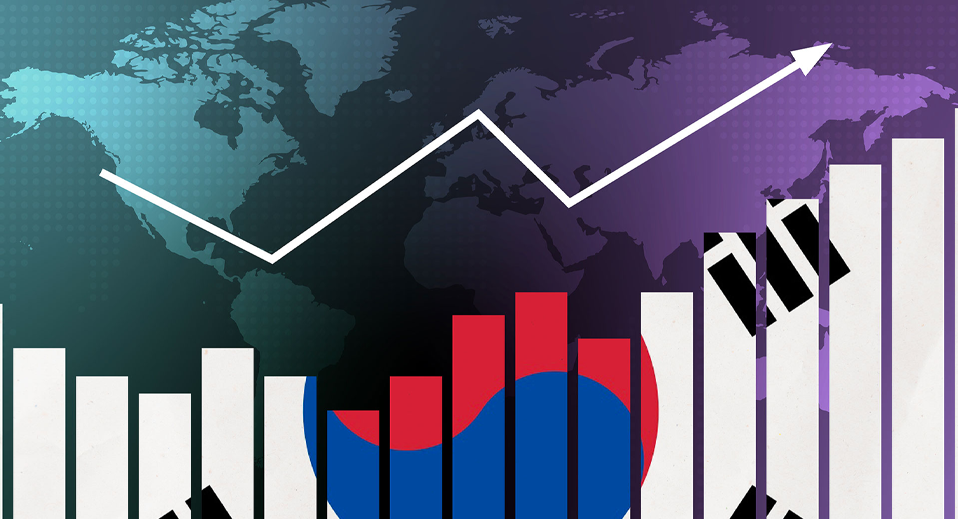



South Korea is undoubtedly at a pivotal moment: the boom in AI and semiconductors is restoring growth, external surpluses and the leeway to undertake financial and monetary reforms, starting with the internationalisation of the won, but this momentum has not yet spread throughout the economy.
South Korea’s strength lies in a very specific comparative advantage: its dominance in memory components. Samsung Electronics and SK Hynix, two global vertical integrators, design, manufacture, test and market their own chips, enabling them to coordinate R&D, mass production, yields and investment on a very large scale.
South Korea’s industrial strategy currently pursues three objectives. The first is to strengthen production capacity. The second aims to reduce external dependence, particularly on China for rare earths, through the diversification of sources, strategic stockpiling, recycling and the development of a domestic sector for the separation, refining and production of magnets. The third aims to close the gap in Korea’s capabilities in the field of logic semiconductors, design and equipment manufacturing.
This success, however, raises the question of excessive dependence on a very specific sector. South Korea is experiencing not so much overall growth as a supply shock and a surge in technological investment, the benefits of which for households are delayed and unevenly distributed. Since the end of the Covid-19 pandemic, nominal wages have risen, but purchasing power has followed a highly uneven trajectory. The share of consumption in GDP remains below its pre-Covid level, and private consumption remains fragile, held back by virtually stagnant real wages, inflation above target and very high household debt.
The risk of a ‘Dutch disease of semiconductors’ is real, even if this is a sector-specific variant: a technological competitiveness windfall and an AI-driven demand shock are concentrating capital, profits, talent and political attention in a highly capital-intensive sector that creates few jobs, yet without any sustained appreciation of the won at this stage.
The central question is therefore whether South Korea can convert this positive shock into a new, more balanced growth model, driven by consumption, services, productivity and financial depth, or whether the country risks repeating its historical vulnerability: a highly open, highly industrialised economy, yet dependent on a small number of technologies, markets and a global investment cycle.
The ultimate tension is therefore not only between growth and redistribution, but between the short-term cycle – exceptional profits and tax revenues – and structural needs – an ageing population, housing, the energy transition and regional rebalancing. It is precisely this dilemma that makes the ‘Korean moment’ both promising and still uncertain.
Three scenarios
Scenario | Mechanism | Consequences |
‘Korean moment’ confirmed |
|
|
Prolonged sectoral cycle |
|
|
Asymmetric overheating |
|
|
Find all Economic Research publications on