
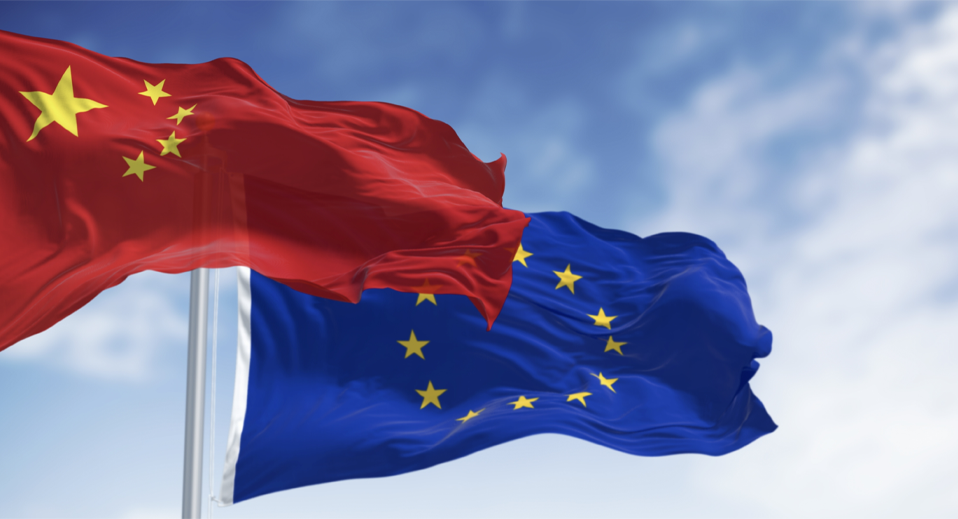




The first ‘China shock’ turned China into the world’s factory. the global balance of industrial and technological power. Faced with this “China Shock 2.0”, Europe must not only respond, but above all act.
The first China shock is generally associated with China’s accession to the World Trade Organization in 2001. At the time, its competitive advantage rested primarily on very low production costs, underpinned by an abundant and inexpensive labour force. China gradually emerged as the world’s manufacturing hub, exporting vast quantities of relatively simple, low-cost goods to advanced economies. For Western consumers, this translated into lower prices and higher purchasing power.
Today, the nature of the challenge has changed profoundly. China no longer competes with Europe solely on entry-level or low value-added products.bIt has become a major competitor in strategic industrial and technological sectors, from electric vehicles and batteries to green technologies and artificial intelligence.
In other words, the first Chinese shock was that of low-cost ‘Made in China’ goods. The second is about the emergence of China as a leading industrial and technological power, capable of combining innovation, mastery of cutting-edge technologies and price competitiveness.
Beijing’s objective is clear: to reduce its dependence on the outside world and establish itself as the world’s leading industrial and technological power, particularly in the face of its major strategic rival, the United States. This ambition is underpinned by a model of state capitalism that channels substantial public support towards industry through subsidies, abundant financing and long-term strategic planning
The Chinese authorities have thus chosen to invest heavily in their productive capacity. The authorities support firms, direct resources towards priority sectors and foster the emergence of national champions capable of conquering global markets. This strategy has helped China to build up impressive industrial power. But it comes at a cost: resources are disproportionately channelled towards investment and production rather than consumption, weighing on Chinese households’ purchasing power.
This model is now beginning to show its limitations. China’s production capacity has grown much faster than domestic demand. The result is growing overcapacity, which intensifies competition in the domestic market, exerts downward pressure on prices and weighs on corporate profitability.
To keep growth on track, China must export and invest ever more, even as returns on investment decline and debt continues to accumulate.
Behind China’s industrial successes, therefore, lie imbalances that could, in the long term, undermine this model. But for Europe, their consequences are already very real.
China’s excess capacity is increasingly spilling over into global markets. Supported by state subsidies and a competitive exchange rate, Chinese products are exported at highly competitive prices, distorting competition and putting growing pressure on European industry and employment, as illustrated by the automotive sector.
The appropriate European response is not to close borders or embrace protectionism, but to ensure a level playing field. Europe can draw on a range of instruments, from anti-dumping and anti-subsidy measures to safeguards, anti-coercion measures and reciprocity in access to public procurement.
Europe therefore does not lack tools,although their use is constrained by its commitment to WTO rules. . What it also lacks is the unity required to use them more swiftly and consistently. The real key to success is therefore political. Indeed, Beijing has often been able to exploit divisions among Member Statesto undermine Europe’s ability to defend its own interests. Faced with a China that increasingly uses economic competition as an instrument of power, Europe must with greater unity, coordination and strategic clarity, protecting its industrial interests without sacrificing the openness that remains one of its key strengths.
This defensive response must, however, be accompanied by a genuine offensive strategy, placing European sovereignty, resilience and competitiveness at its core. Europe must focus its efforts and investments on the strategic sectors that will shape tomorrow’s value creation, technological leadership and economic autonomy. The aim is therefore to combine targeted protection, joint investment and a preference for European products when economic security is at stake. Ultimately, Europe lacks neither ambition nor resources: its main challenge now is to turn intentions into action, with the speed and determination needed to deliver tangible results.
The ‘Chinese shock 2.0’ is no longer merely a challenge to competitiveness. It is a challenge to industrial, technological and geopolitical power, to which Europe must respond collectively if it is to preserve its place in global competition.
Find all Economic Research publications on our website